Living House
“You are the building. Residents decorate you. You decide what stays.”
Living House is a cozy fairytale idle game for mobile. The player isn't a builder, decorator, or city manager — they are the building itself. From a single hut to a sprawling castle, the building grows over real-time days as autonomous residents arrive and decorate it according to their own taste. The player's role is curatorial: approve, replace, freeze, or sabotage what each resident proposes. The building's character emerges from a long sequence of small refusals.
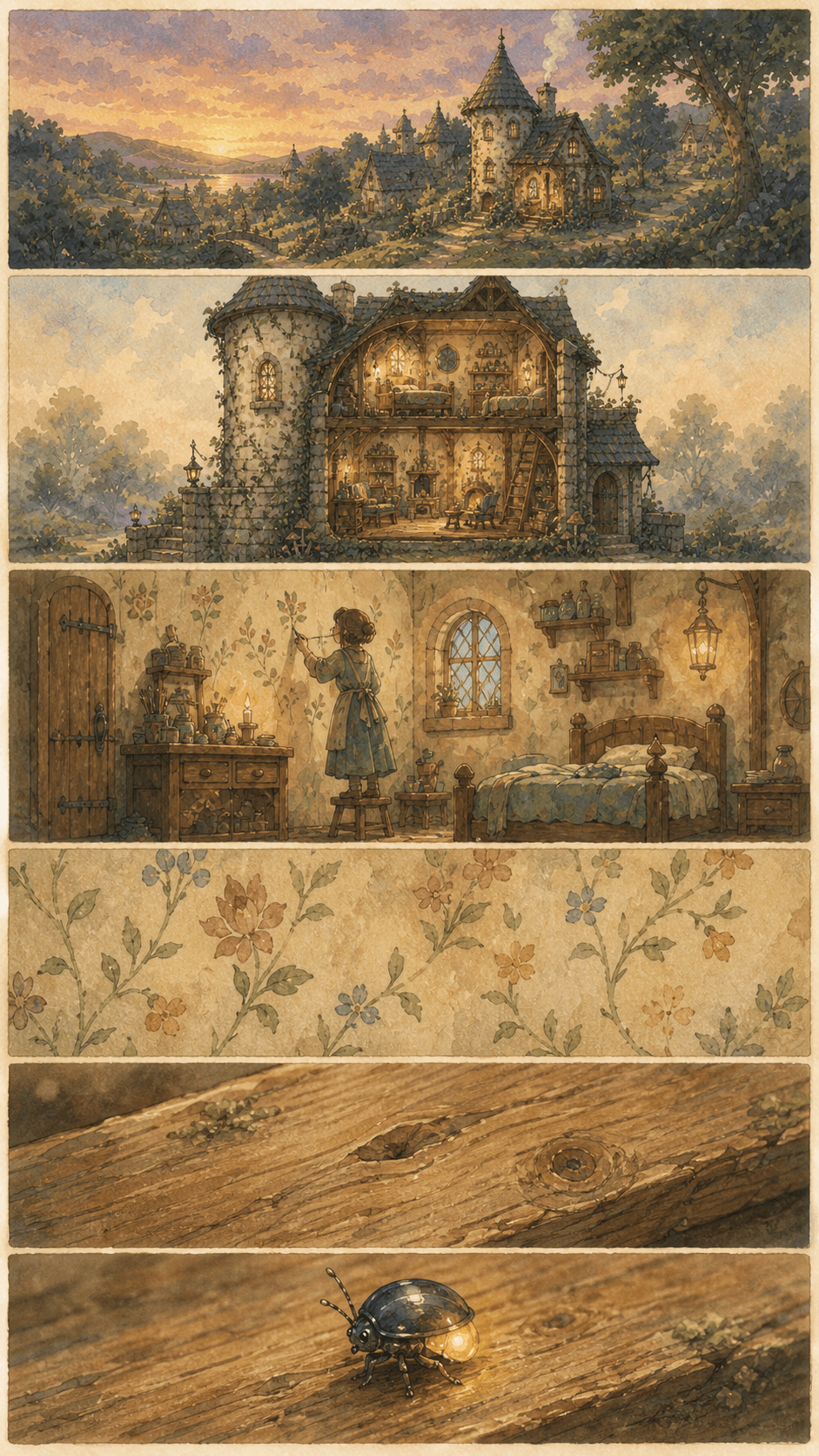
Most decoration games hand the player a paint-bucket. Living House inverts that. Residents are not units — they're characters with names, signature repertoires, and quirks. A Legend tilemaker only works on moonlit nights. A Master wallpaperer freezes one piece of work as a permanent style anchor; everyone else adapts around it. One veto triggers a cascade: the floor changes, then the ceiling adjusts, then the windows reconsider. Six zoom levels run from a wide neighborhood view down to a single room — and even the smallest inhabitants (beetles in the cracks, lantern-bugs in the walls) can become pets with their own mechanic when observed long enough without being chased away. Permeability turns the daily session loop into a real choice: an open window lets the sun warm the room, but a passing rain leaves the wallpaper damp by morning.
The design is built around a 60-second morning session: pinch-zoom into one room, review what a resident proposed overnight, approve or veto, drop a level to check the microcosm — beetles in the cracks, lantern-bugs in the walls — then close the phone. A single 3D scene carries orthographic zoom across all six levels, so the world stays continuous instead of splitting into menus. The core loop, resident systems, and spatial architecture are laid out across four interlocking design documents — roughly twenty pages of prose, diagrams, and tables.
Underneath everything sits the simulation of taste. Each resident's decoration choices feel personal rather than random — driven by traits, location, neighboring work, mood, and history — without drifting out of the intent the player has curated. The engine is a tag-and-weight system: every proposal weighs the resident's traits against the room's dominant tags, the nearest anchors, and the player's veto history. The wallpaperer is the canonical example — she reads the room, samples her repertoire biased toward its tags, and re-weights after each veto so the next proposal is closer to what the player would leave alone.